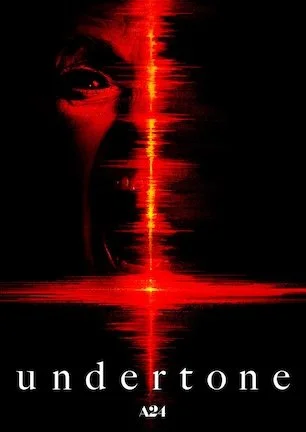
Studio: A24
Director: Ian Tuason
Writer: Ian Tuason
Producer: Dan Slater, Cody Calahan
Stars: Nina Kiri, Adam DiMarco, Michele Duquet, Keana Lyn Bastidas, Jeff Yung
Review Score:

Summary:
The skeptical host of a paranormal podcast grows unnerved as she sees disturbing similarities emerge between mysterious audio files and her troubled personal life.
Review:
Through genre releases that include “The Blackcoat’s Daughter” (review here), “Hereditary” (review here), and “The Lighthouse” (review here), A24 earned a reputation for slow-burn suspense where eerie atmosphere creates arthouse appeal. They typically traffic in “elevated horror” that attracts mainstream attention for being offbeat, experimental, or psychologically unsettling, as opposed to low-rent DTV sequels about killer puppets made for undiscerning stoners.
“Undertone” certainly fits the criteria for an A24 thriller. In addition to focusing intently on making a macabre mood, only two actors ever appear onscreen, and one of them doesn’t even speak. The entire film also takes place inside a single house. These can often be earmarks of a DIY project trying to churn out a cheap flick, yet these are all necessary components in “Undertone’s” plan to develop an intangible aura of dread that comes from vibes more than from visuals.
As with any boutique brand, not all A24 fright films are created equal. “Undertone” is partly produced by Black Fawn Films, a Canadian company known for horror movies that can be visceral or cerebral. Either way, and regardless if they are hits or misses, their titles generally have the touch of being crafted with a genuine appreciation for horror’s history rather than as one-off larks by auteurs who’d rather be making period dramas or droll comedies. As such, “Undertone” blends the Black Fawn feel with A24 aesthetics to create slow-burn suspense that’s taken seriously, but not to the point of highbrow pretentiousness.
Main character Evy appears in every scene of “Undertone.” Partnered with her unseen, “true believer” pal Justin, Evy occupies the skeptic side of the duo’s paranormal podcast. Evy recently returned home to care for her bedridden mother, who lies unconscious and unresponsive except for occasionally inexplicable movements Evy never witnesses, so Evy records from there while Justin calls in from a separate location.
For their latest episode, Justin and Evy dive into a collection of 10 audio files Justin received from an unknown email address with cryptic messaging. Normally, clicking an unsolicited attachment from an anonymous sender is a great way to give a computer a virus. In this case, it’s a great way to create content, because the files form a mystery around a man named Mike and his girlfriend Jessa, whom Mike started recording to capture what Jessa says in her sleep.
What Mike captures is a perplexing series of children’s songs, words spoken backwards, loud thumps in the night, an unidentified baby crying, and Jessa shrieking. Justin and Evy’s research into the clues uncovers grisly connections to folklore about mothers murdering their children, perhaps driven mad by Abyzou, an infertile demon motivated by envy to cause miscarriages and kill infants. Over the course of listening to these recordings, Evy sees strange similarities bleeding into her problem-plagued personal life as noises, visions, and possible paranormal activity seemingly parallel the ordeal Mike and Jessa went through.
“Undertone” operates a bit like an aural counterpart to “Skinamarink” (review here). Where that movie is essentially a feature-length montage of supposedly spooky imagery, “Undertone” initially plays like an assembly of sound bites, audio cues, and creepy music for an ongoing medley meant to unnerve ears.
A key difference between these two films is that a clear story eventually emerges so “Undertone” doesn’t rely solely on the haunting echoes of nursery rhymes or backmasking to carry the full weight of its frights. “Skinamarink” leaves it entirely up to the audience to create their own context. Those who don’t or can’t end up eating a nonsensical series of props and pictures. “Undertone’s” focus on audio forces imaginations to fill in visual blanks, but its obvious theme of parental anxiety means no one has to invent their own metaphors to find meaning behind the movie.
Another difference between “Skinamarink” and “Undertone” is that there’s far more filmmaking technique on display here. Slow zooms are a staple of “Undertone’s” cinematic style. Setups are framed to deliberately obscure details, like a nurse making a house call who is hidden by a wall. The camera has a habit of gliding casually, shooting Evy from angles where what she sees can’t be seen by the viewer, or making it feel like an invisible presence floats around her periphery. Again, atmosphere is important to this movie, and while the camera isn’t actively kinetic, writer/director Ian Tuason and director of photography Graham Beasley have clearly considered how to subtly compensate at least a little bit for the absence of action and repeated looks at the same person and location.
Making one more comparison to “Skinamarink,” “Undertone’s” atypical texture as audio-first horror that’s compact and patient makes it a divisive “love it” or “hate it” film where different viewers will have different experiences. Some will be enthralled by its hypnotic dreaminess and grim mystery. Others may be bored by the pace’s gradual build amid a narrow spotlight on one personality they may not take to. Since she’s onscreen so much, investing in Evy is important to synching with the story. Nina Kiri does well with a role that demands a lot from her face, though her perpetual dourness can add to the drag.
A piece of advice that applies no matter where one falls from the fence is to not look at “Undertone” with a lot of logic, since its timeline of events doesn’t hold up to reasonable questioning. The key piece of each audio file lasts less than a minute, yet Evy and Justin choose to listen to them in four separate sessions rather than all at once. It’s baffling that whenever the mystery deepens, they decide to wait until another day to go further even though all of the info is right there in front of them. Mike and Jessa’s recordings are the core of the podcast, but Justin and Evy only record a few minutes at a time. How short is each episode? Oddest of all is how long Justin waits before researching the email address that sent the files and then never researching Mike or Jessa at all.
Let this be one final reminder that “Undertone” is a dish best eaten for its frightful flavor. Looking too closely at the ingredients or complaining about the cutlery might spoil the mood-drenched meal.
Review Score: 55
With fewer thrills and a setup that’s harder to swallow a second time, “Fall 2: Deadpoint” might be a case of draining the well dry.