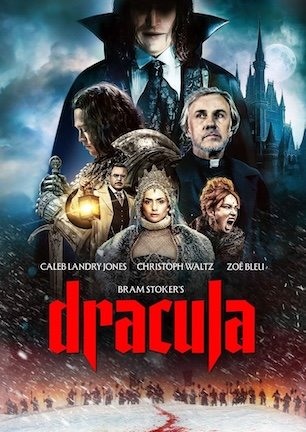
Studio: Vertical
Director: Luc Besson
Writer: Luc Besson
Producer: Luc Besson
Stars: Caleb Landry Jones, Christoph Waltz, Zoe Bleu, Matilda De Angelis, Ewens Abid, David Shields, Guillaume de Tonquedec
Review Score:

Summary:
400 years after becoming a vampire, Dracula resurfaces in Paris in search of his beloved wife’s reincarnation.
Review:
Filmmaker Luc Besson’s overindulgence in the bombastic theatrics of extravagantly armored soldiers on horseback, gaudy gold gilding decorating a grand ballroom’s costumed dance number, and generally garish period-piece pageantry spanning two separate eras shouldn’t be mistaken for elegant auteur artistry. Originally titled “Dracula: A Love Tale,” “Dracula’s” comparatively high production value may put it above the cheesy cheapness of “Lost in Space” or Adam West’s “Batman,” but it’s just a flashier heap of pure camp from beginning to end, made even more amusing because the movie doesn’t exhibit the self-awareness to realize it.
Snickers start immediately, with Prince Vlad Dracula and his beloved wife Princess Elisabeta demonstrating their deep passion for one another the way all royal couples presumably do: by having a pillow fight in slow motion. The wordless montage meant to make their undying love the story’s anchor doesn’t include poetic endearments, joyful tears of emotion, or silhouettes against sunset landscapes. It does, however, include a mini-food fight where they sloppily push porridge into each other’s mouths, awkwardly dance in Ebeneezer Scrooge dressing gowns, and ignore their rose petal-covered bed to have sex up against a wall as though they’re in a dive bar bathroom.
Like Superman’s odyssey from the doomed planet Krypton or Batman’s parents getting gunned down in Crime Alley, Dracula’s origin is among the most done-to-death tales in fiction. That doesn’t stop writer/director Besson from retelling it for the hundredth time, or from quizzically creating a visual template that’s nearly identical to Francis Ford Coppola’s 1992 film.
When the cursed count reappears in Romania 400 years after his wife’s death inspires the blasphemy that turns him undead, Dracula’s prune head sports a bizarrely bouffant white wig that screams, “You thought Gary Oldman’s dueling beehives looked ridiculous? Hold my chalice of rat-blood wine.” The shape is so unserious, it makes the gargantuan rings turning Dracula’s hand into a bejeweled catcher’s mitt seem like a modest design choice by default.
Should you need more absurd sights, “Dracula” has plenty to go around. Leading the pack is a hilarious cutaway after a despondent Dracula desecrates a church by slaying a cardinal, then we see a polka dot-dressed Jesus weeping blood on a crucifix while Danny Elfman’s surprisingly vanilla score bursts into a pompous crescendo. Perhaps you’d prefer Dracula’s dwarfish minions from Salacious Crumb’s family tree of goofy computer-animated gargoyles? How about hypnotized nuns forming a writhing tower of bodies so they can hoist Dracula like a crowd-surfing rockstar toward a night sky streaked by incessant lightning strikes, another staple of the film’s overwrought style?
Given the aggrandizing tone overall, it’s a minor marvel the dialogue doesn’t meet the music and imagery at their levels of pretentiousness. Not for lack of trying. “Living without love is the worst disease of all, my friend. It is like a fine, incessant rain. It gradually eats away at your bones, turning you into a form of sponge, unable to stand upright.” Huh?
As cinema history has proven time and again, unintentional silliness isn’t sustainable for 129 minutes worth of ironic entertainment. Once the vague fun factor of a Full Moon feature blowing up a big budget wears off, “Dracula” turns into a long, slow slog through dry drama.
The subtitle is/was “A Love Tale,” but Dracula doesn’t meet Mina, his wife’s reincarnation, until almost 80 minutes into the movie. The main scene of Dracula starting to seduce Mina involves attending a carnival together, except they have Mina’s friend and Dracula’s enslaved servant Maria tagging along to make a trio. In between eating crepes and applauding a puppet show, Dracula observes from the background as the women sip sherry and throw bean bags at cans on the midway. Is there any better way to rekindle a centuries-old romance than by standing behind your beloved as she and her bestie gawk at a bearded lady inside a crowded circus tent?
Performances can be described by each cast member’s predominant expression. Caleb Landry Jones’s perpetually pained face looks like he’s ready to imitate another Gary Oldman role in a different Luc Besson film by shouting a volatile “Everyone!” at any moment. Playing an underwritten Van Helsing surrogate as a priest who curiously goes unnamed, Christoph Waltz looks like he got lost on his way to a better role, yet he decided to stick around with a distracted stare to see how many more cars might pile up in this trainwreck.
Put together like a made-for-TV movie with the misspent money of a theatrical blockbuster, “Dracula” has a hard time finding a buoy to save it from drowning in the endless ocean of Dracula adaptations. “Bram Stoker’s Dracula” does almost everything the same, but exponentially better. Robert Eggers’s “Nosferatu” (review here) predates it by only one year. And “Argento’s Dracula” (review here) already beat Besson to the punch by having the Italian maestro be the first formerly unstoppable artiste to deliver a disappointing Dracula past his career’s prime. Luc Besson’s “Dracula” may have to settle for an asterisk as a film weirder than any oddity in the mermaid-headlined freakshow Dracula attends with the object of his affection and her gal pal.
Review Score: 45
You immediately know you’re in for a wild ride through nostalgia and nightmares like only Casper Kelly can conjure.