Studio: Toho/Neon
Director: Genki Kawamura
Writer: Kentaro Hirase, Genki Kawamura
Producer: Yuto Sakata, Kenji Yamada, Akito Yamamoto, Taichi Ito
Stars: Kazunari Ninomiya, Yamato Kochi, Naru Asanuma, Kotone Hanase, Hirota Otsuka, Tara Nakashima, Reo Soda, Mikio Ueda, Hikakin, Nana Komatsu
Review Score:

Summary:
Inexplicably lost in a supernatural subway tunnel, a man must confront a crisis of conscience while navigating a series of anomalies to find an exit.
Review:
As I usually do when I think it might matter to fans of the source material who are curious about consistency, I mentioned in a recent review of a movie based on a book that I hadn’t read the original novel. My memory casually clocked that this seemed like an asterisk I had been putting on a lot of film adaptations. Coupled with an ongoing effort to read more, I made a mental note that in the future, I wanted to be better versed in an adapted movie’s origins so I could speak on the subject with a little more background knowledge.
An easier opportunity to do that without having to read a lengthy novel came with “Exit 8.” “The Exit 8” is an indie video game I had heard about here and there, so when it came time to cover the movie version, I thought I should play the game first so I could have that context for my review of the film. After all, it was available for free with PlayStation Plus, and it looked like a quickie since it only had a paltry four trophies to obtain. How Long to Beat said it could be completed in under an hour. Two people posted being able to get through the whole thing in 45 minutes, with one of them adding he did a second run in just over six minutes. With such a low investment of time on the table, it was an easy call to give “The Exit 8” a go.
I didn’t know much about this first-person puzzle game besides its basic premise, which is that you’re someone stuck inside a subway station corridor that continually loops until you manage to find the titular exit. Here’s how it works:
You start in a long hallway. On the left wall are six posters and a sign. On the right wall are three doors, two vents, and an emergency console. Miscellaneous fixtures include fluorescent lights overhead, a yellow line on the floor, and a couple of bubbled security cameras on the ceiling. There’s also a silent, briefcase-carrying man walking toward you. If you turn around and follow him, he simply stands still and looks at his cellphone.
Initially, there aren’t any instructions, either onscreen as a tutorial or in the Pause menu. Any button pressed merely makes you move faster, which is a godsend since the normal walking pace moves with the urgency of a 100-year-old man with a cane.
If you move to the end of the corridor, you can turn left into a small hallway. A right turn, then a left turn takes you through two more nondescript tunnels. One more right turn puts you back where you started, in the distinct corridor with the man still walking toward you.
Based on what I gathered from the trophy descriptions, it seemed like what you’re supposed to do is search for “anomalies,” which I took to mean “The Exit 8” was essentially a horror version of “Spot the Differences” or “Concentration.” I assumed this meant I needed to look for posters that changed, doors that moved, or something like that, although I had no idea what I was supposed to do when I found an anomaly.
I went back and forth, this way and that several times, and I never noticed anything different. I didn’t want to make a job out of the game by having to write things down, so I simply made mental notes like, “this poster is for a dentist” or “the date on that one is such and such.” Only some of the text was in English, with the majority being in Japanese, so many of the words were an unrecognizable blur.
After a couple of completely uneventful loops, a sign magically appeared to finally explain what to do. If you see an anomaly, turn around to go back in the opposite direction. If you don’t spot anything strange, keep going forward. If you follow these steps correctly, the numbered sign posted after passing each corridor will advance until it hits Exit 8. If you make a mistake though, the game resets you at Exit 0.
The “scarier” anomalies are easy to notice. Lights might flicker. Unusual sounds might be heard. Others are much more elusive, to the point that “The Exit 8” becomes a tedious exercise in catching nearly imperceptible distortions or making lucky guesses if you should go backward or not.
Now that I knew what to do, I made it to Exit 4. I didn’t notice anything out of the ordinary here, yet when I continued forward, I was back at Exit 0. Ugh.
My next run made it to Exit 5. Again, I didn’t see anything unusual in the corridor, so I chose to move forward. Again, I was sent back to Exit 0. Seriously?
The third time through, I made it to Exit 2 by going forward through perfectly plain hallways. Exit 2’s tunnel looked normal too, but continuing ahead sent me back to start over yet again.
What could I possibly be missing? Do I need to check that every letter on each poster is still the same? Do I have to wait and see if the walking man does anything different during his amble?
Being back at Exit 0, I decided to take one last stab. Seeing no anomalies, I moved forward and made it to Exit 1. It didn’t look like anything was different here either, so I went forward and advanced again. Even though Exit 2 still didn’t look any different, I should have guessed the odds were low on three nothings in a row because, whoops, I went forward and thus went back to the beginning at Exit 0. I knew no matter what, my next choice was definitely going to be the right one.
Like How Long to Beat predicted, I finished “The Exit 8” in 45 minutes because once the clock hit that amount of time, I uninstalled the game and turned off the PlayStation. I even deleted “The Exit 8’s” trophy history from my gamer profile so this written admission right here is the only evidence I ever wasted my time on this thoroughly boring disappointment. I refused to cheat by looking up a walkthrough, because I felt if the gameplay was really as pedantic as noticing if a No Smoking sign’s cigarette had two fume lines instead of three or whatever, then “The Exit 8” can get f*cked for being no fun at all. There’s a Grand Canyon gap between teasing a person’s brain with a worthwhile puzzle and punishing a player for not spotting a minor detail they don’t even know to look for.
Now I had second thoughts about watching the movie because I feared “Exit 8” might end up being as slow moving, excruciatingly repetitive, and frustratingly empty as the game that spawned it. Some might think the film is those three things. This could be a rare case where the source set expectations so low that the adaptation had nowhere to go but up, but I’d tell anyone who didn’t play the game and disliked the film that I never would have imagined that between the interactive experience and the passive one, the most immersive, meaningful, and memorable of the two is the movie.
How do “Exit 8’s” filmmakers make a feature film out of a barebones game that has no story, no dialogue, and can be completed in seven minutes? By dropping a small handful of characters inside the supernatural loop premise and shaping their development around a heavy crisis of conscience theme.
“Exit 8” recreates the game’s environment almost exactly. The main corridor appears practically identical. So does the briefcase-carrying man walking in the opposite direction. There are some differences, such as adding a set of lockers in the second hallway instead of leaving it empty, though this seems intended to insert a bit involving a crying baby without having to visually reconfigure the primary corridor.
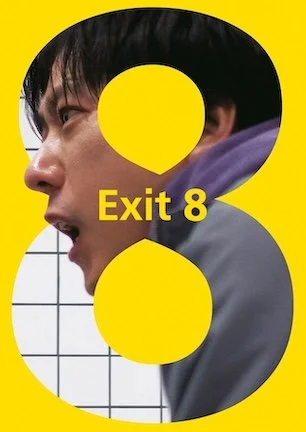
“Exit 8” mainly follows an average, unnamed man out of a crowded subway car into the strangely deserted subway tunnel. He makes a couple of circuits around the repeating walls and quickly becomes confounded when he realizes he is inexplicably trapped in a recurring loop and doesn’t understand what is going on. I feel for you, my man. I’ve been there. Literally.
Where I haven’t been is in the more personal predicament he concurrently faces. Shortly before entering this cerebral nightmare, the young man receives a cellphone call from an ex-girlfriend who is pregnant. With the rift in their relationship, and with his apprehension about potentially becoming a father, neither of them knows what to do. Being lost in uncertainty becomes an unsubtle parallel for the more immediate situation the man finds himself in.
It takes him about as long as it took me to figure out what needs to be done in the tunnel. After this, the man goes through a serious of experiences ranging from slightly odd to unsettlingly terrifying. A lot of things can be done inside a surreal setting like this, where logic doesn’t apply. “Exit 8” doesn’t go too far off the fantasy leash, but it does slip in some weird rat creatures that melt into human faces, raging floodwaters, and smaller frights like the walking man smiling menacingly or eyes watching from one of the signs.
After 40 minutes of following the lost man as he walks forward and backward encountering paranormal sights and sounds, or encountering nothing unusual at all, viewers will inevitably wonder, “Are the next 50 minutes going to be more of this until he finally finds Exit 8?” Rather than continuing this routine, “Exit 8” flips its perspective here, putting the lost man on ice temporarily to show the briefcase-carrying man’s POV. This is also the point where the movie’s metaphors come into full view, as this sequence also introduces a lost little boy who ends up as a companion to both men. Once the walking man’s side story reaches a resolution, “Exit 8” returns to the lost man’s journey with a clear picture of how each character relates to each other, and how their ordeals symbolize choices they’ve made regarding where to go in life.
By nature of its concept, and enhanced by how the sterile space is presented as well as accented by eerie audio, “Exit 8” drips with a haunting, hypnotic quality. There’s an instinct to call it a slow burn due to how casually it inches forward, except the narrative isn’t really what’s smoldering. “Exit 8” is meant to be more of a moody experience, for the trapped characters and for entranced viewers, than a strictly patient psychological thriller.
An acquired taste as both a film and a game, the movie version of “Exit 8” keeps its ongoing drama and light Lovecraftian touches compelling enough to smooth over long lulls and lapses in horrible happenings. Fleshing out the fiction far more than the game ever does, the movie is interesting enough that I briefly considered redownloading “The Exit 8” to give it one more try. Better sense kicked in, however. I’d rather remember “Exit 8” as a compact, captivating creeper that has something to say, even if its message is on the nose, rather than as a game that’s a big drag to play.
NOTE: The movie’s Japanese title is “8-ban deguchi.”
Review Score: 70




With fewer thrills and a setup that’s harder to swallow a second time, “Fall 2: Deadpoint” might be a case of draining the well dry.