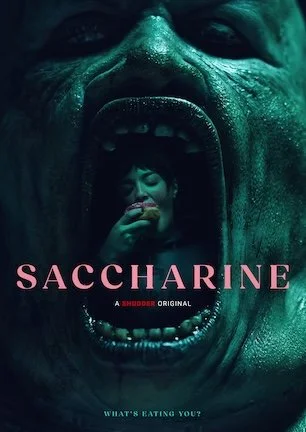
Studio: IFC/Shudder
Director: Natalie Erika James
Writer: Natalie Erika James
Producer: Anna McLeish, Sarah Shaw, Natalie Erika James
Stars: Midori Francis, Danielle Macdonald, Madeleine Madden, Robert Taylor
Review Score:
Summary:
A med student with body image issues takes a weight loss pill made from human ashes, and finds it has the side effect of binding her to a haunting presence.
Review:
Med school student Hana doesn’t like how she sees herself in the mirror her mind made. It isn’t just the distressing digits on her bathroom scale, which she records with the same obsessive compulsion compelling her to regularly medicate stress with junk food. Whether it’s Hana’s obese father having a security camera installed to monitor his refrigerator raids, or a bloated cadaver whose painted nails match the color on her own fingers, Hana can’t stand to confront any detail that reminds her of the poor body image sapping her self-esteem.
Hana has two paths in front of her to go from pessimistic to positive about her weight. The first is a 12-week fitness course offered by her gym, though that’s just as much to indulge in her crush on the attractive instructor, Alanya, as it is about being healthier. The second is a more unconventional approach to losing unwanted pounds.
Given a small sample from a former friend who halved her size since she was last seen in high school, Hana discovers a miracle diet pill that really works. No matter how many calories she consumes, the number on her scale keeps going down. Unfortunately, the high price of these pills puts a steady supply well out of Hana’s reach.
Thinking she might be able to concoct a generic alternative, Hana performs a lab test to uncover the wonder drug’s contents. Imagine her surprise when she discovers the key ingredient is cremated human remains. Just as weirdly, Hana’s med school status gives her access to corpses, meaning she actually can recreate the macabre medication and keep her peculiar weight-loss plan going.
Hana quickly discovers a side effect that would never have been listed on any label. The pill comes with a paranormal presence, visible only in reflections, and the entity takes an eerie interest in ensuring Hana doesn’t miss a dose so she can still gorge on cookies, cakes, crisps, and chips. Although Hana continues getting thinner despite the food still stuffed in her stomach, the frightening figure seems to grow in response, and the ways it haunts Hana become increasingly disturbing.
Men can and certainly do experience eating disorders, as represented by the character of Hana’s homebound father who can’t get around without help from his mobility scooter. However, Hana’s father is the only male figure of any real note, with one other being a fellow student who somewhat cruelly nicknames an oversized cadaver “Bertha,” making “Saccharine” a very female-forward movie. Hana’s best friend, love interest, and the mother who constitute her primary interactions are all women. Not that men can’t equally appreciate the film as art or as entertainment, “Saccharine” merely earns this mention for having a thematic specificity that directs its material at some demographics more than others.
The other asterisk to take into consideration is “Saccharine’s” intent to appeal to imaginations moving in step with its arthouse aesthetics. Those who naturally take to atmospheric, metaphor-filled horror should still approach with informed reservation. Even the slowest of slow burns don’t often hit this low of a speed. “Saccharine” is not without activity, but it is not sustained by action-packed intensity.
Most of the movie walks by with minimal spoken dialogue. Tumultuous thoughts turning over in Hana’s head are chiefly expressed through reactions on her expressive face, brief looks at lines she writes in a journal, and bouts of binging that highlight the agony and the ecstasy of eating as an addiction. Psychological drama occasionally solidifies into physical scares whenever there’s a quick glimpse of the entity, or when it invisibly stalks around to unsettle Hana, though visceral shocks aren’t the side of the bread where the film butters its suggestive dread.
Obviously, the movie means well with its message warning against dangerous extremes dominating a desperate search for acceptance, from others as well as from yourself. Yet it’s difficult to enthusiastically recommend “Saccharine” because that message doesn’t dig deep. As an illustration of body image issues manifesting as a parasitic “demon” of sorts, “Saccharine’s” impact doesn’t resonate as much more than a common cautionary tale about compromising one’s character in pursuit of an unrealistic ideal that’s been perverted by misperceptions. This lower-budget look inside a fracturing psyche also has a hard time making a splash when similar efforts such as “The Substance” (review here) already made bigger waves with overlapping ideas.
Taking a long, roundabout road to reach its expected destination, “Saccharine’s” four-door sedan limits it to surface streets of suspense while more impressive sportscars race by on horror’s highway. That could be a crass analogy to make when discussing a film where the lead wishes she were a sleeker, sexier, more appealing model of essentially the same vehicle. Sadly, the comparison seems apt for a movie whose comparatively ordinary construction has a difficult time holding its own against competitors in the same class.
Review Score: 55



With fewer thrills and a setup that’s harder to swallow a second time, “Fall 2: Deadpoint” might be a case of draining the well dry.