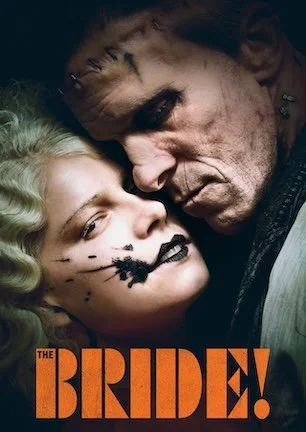
Studio: Warner Bros. Pictures
Director: Maggie Gyllenhaal
Writer: Maggie Gyllenhaal
Producer: Maggie Gyllenhaal, Emma Tillinger Koskoff, Talia Kleinhendler, Osnat Handelsman Keren
Stars: Jessie Buckley, Christian Bale, Peter Sarsgaard, John Magaro, Jeannie Berlin, Annette Bening, Jake Gyllenhaal, Penelope Cruz
Review Score:
Summary:
Shocking acts stemming from an unusual romance between Frankenstein’s Monster and a resurrected woman spark a cultural rebellion centered in 1930s Chicago.
Review:
Timing matters when writing, and especially when reading, a movie review. Savvier film fans already know to add a grain of salt whenever heaps of hype come out of a festival, where overzealous lemmings hypnotized by electric atmospheres froth at the mouth to trumpet effusive acclaim when what they really want to do is brag about being the first bandwagoner on the train. Add another grain whenever hyperbolic gushing follows a glitzy Hollywood premiere, where influencers might be the ones being influenced by a big studio’s wining, dining, and swag bags of exclusive items.
Even after a movie releases to the general public, it remains important to consider when a review’s words were put down on the page. Take writer/director Maggie Gyllenhaal’s “The Bride,” or “The Bride!” with an exclamation point for those who prefer to hear the title screaming. Going only off of what was being said when the film first hit theaters in March of 2026, someone might be led to believe “The Bride” was the best thing since sliced bread. One critic called it “your new favorite movie,” adding that there was “no bad news” to report with his 90/100 score. Someone else hailed the film as “an explosive representation of social disruption.” Others collectively mused it wasn’t too early to talk about awards, praising performances and Gyllenhaal’s quirky creativity for forcing fresh air into familiar concepts through subversive artistry.
Fast forward two months to “The Bride” dropping on Blu-ray after already being available to rent digitally at home. Social media circles devoted to horror had long since changed topics. Mainstream outlets had newer media darlings to crow about. In under eight weeks, “The Bride” went from a ballyhooed blockbuster you couldn’t miss if you wanted to be in on the conversation everyone was supposed to be having, to a quickly eclipsed title no longer chirping on the entertainment radar.
Were early adopters knowingly or unknowingly contributing to an exaggerated narrative inflating the film’s importance? Were ordinary audiences less enthusiastic because they simply didn’t see the bigger picture Maggie Gyllenhaal was painting with a brash brush of timely commentary cleverly coloring her original take on the tragic tale of a monster and his mate? As is usually the case, an objective perspective lies somewhere between two subjective POVs, and individuals will lean toward one or the other depending on how much, or how little, they get out of the movie.
“The Bride” is an exercise in extremes in ways other than inspiring those two opposing opinions. Gyllenhaal alternates her movie’s mood between two extremes as well, with one being an inclination to overexpose obvious themes in bright neon floodlights, or else hiding intentions deep in cryptic confusion often brought on by overwrought dialogue and sensationalized character moments whose purposes aren’t even close to clear.
“The Bride” can be seen as a pseudo-legacy sequel the same way David Gordon Green’s 2018 “Halloween” directly follows John Carpenter’s 1978 original. While the movie presents itself as a sequel to Mary Shelley’s novel, someone could alternatively presume “The Bride” takes place within the same world as the 1931 “Frankenstein” starring Boris Karloff, but with all of its sequels ignored.
Since the end of that novel/film, Frankenstein’s Monster (Christian Bale), who gets the nickname “Frank” here, has wandered the world in search of a solution to a century of loneliness. Frank’s travels lead him to Dr. Cornelia Euphronious (Annette Bening), a scientist experienced in rejuvenation, in 1936 Chicago. There, Franks convinces Cornelia to make him a companion out of Ida (Jessie Buckley), a spunky socialite with Mae West’s wit and Clara Bow’s style. Ida recently died a bone-breaking death after publicly shaming a notorious mobster. Even resurrected as a bit of a monster herself, she’s as rebelliously independent as ever, and Frank couldn’t be more smitten with someone so fearless, fearsome, and free-spirited.
What comes next is a cross-country courtship that’s less of a love affair and more of a romantic reawakening for Ida as she comes to terms with who she was, who she is now, and what her involvement with Frank might mean for her future. Along the way, crimes are committed when panicked mobs and policemen react irrationally at the sight of Frank and his bizarre Bride together, attracting the attention of a dogged detective (Peter Sarsgaard) and his intuitive partner Myrna Malloy (Penelope Cruz) in the most on-the-nose “Thin Man” reference ever. Not to mention the crime boss whose gangsters already killed her once wants to see the Bride murdered again after she inspires a wave of vigilantism against misogynist men like him.
Subtle, “The Bride” is not. There’s no mistaking the meaning behind scenes such as a police officer, notably named “Goodman,” pulling the Bride out of a car to sneer lewd jokes in her ear while using his unnecessary pat down as an opportunity to slip aggressive hands up her skirt. Nor is the context unclear in an early scene where a man at a lavish dinner party not only coerces a resistant Ida into slurping an oyster, but compels her to say “please” before shoving the offensive object into her capitulating mouth.
Far more ambiguous in intent than several scenes of attempted assault are the word salads Ida/The Bride regularly tosses with the tongs of an odd accent and odder script. Muttered monologues swell with lines like, “a paucity, a poverty, crumbs from a stifled mind. And they are gobbled, gulped, scoffed, wolfed.” Sometimes patter plays a part, like when the Bride meets Frank with the words, “Slow down, mate. Shipmate. Helpmate. Stalemate. Amalgamate. Imitate. Decimate. Transubstantiate. Sublimate. Consummate. Checkmate,” pausing only to belch out a burp in between.
A peculiar proclivity for dialogue that may or may not mean anything metaphorically or literally can be partially attributed to Ida being inexplicably possessed by the ghost of Mary Shelley. Shelley explains through the fourth wall in a black-and-white prologue that something is cracking in the afterlife, and the only way to get a certain story out of her head is to become a second mind inside Ida. As Shelley puts it, “Here comes the mother*cking Bride,” forecasting a devastating tsunami of defiance that may or may not have a definitive destination.
Cloudy eyes can still see how “The Bride” bangs a loud drum aimed right between the ears of patriarchal power. It’s no coincidence that the Bride is created as a sex object for Frank, yet all attempts to tame her both before and after her resurrection only fuel the grassroots revolution she leads against oppressive gender norms. It’s also no accident that the women she inspires through her daring actions are as intelligent and as assertive as Myrna, who is used to being ignored to the point of invisibility when her male partner is a preferred point of contact. Once again though, what “The Bride” wants to say with a Broadway dance number where Frank and his Bride lead a spontaneous chorus line as a response to an insult, seems very much open to nonplussed interpretation.
“The Bride” is what an experimental film looks like when it’s crafted by longtime Hollywood professionals deciding to do something out of the box without a complete blueprint. There’s an underlying hint of freshmen awkwardly fumbling to film stream-of-consciousness ideas, but the money and talent mean the movie gets a vibrant veneer of highly stylized production design. Because of the names involved, cast and crew have the freedom to take as many risks as they want. Maggie Gyllenhaal and company know that, and they take full advantage of the opportunity to test creative boundaries. Quantifiable results of their experiment, on the other hand, are a separate matter, and one that comes with a mystery regarding how much of a resonant rallying cry “The Bride” really turns out to be in the end.
Review Score: 55
This is Wingard and Barrett letting loose with squibs, stunts, and gnarliness like they did in their indie days.