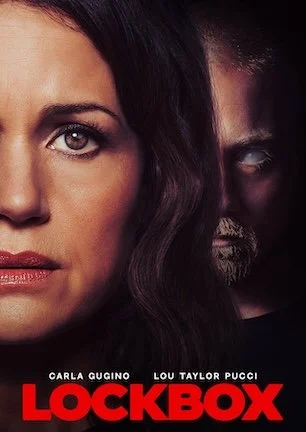
Studio: MGM+/Aura Entertainment
Director: Daniel Stamm
Writer: Justin Yoffe
Producer: Kearie Peak
Stars: Carla Gugino, Lou Taylor Pucci, Katherine Isabelle, Jed Rees, Donald Sales
Review Score:

Summary:
A troubled veteran, his caring cousin, and an eccentric woman become connected to a strange supernatural mystery involving demonic possession.
Review:
Oftentimes, knowing nothing beforehand can be a terrific way to watch a movie, because your imagination is free to engage in immersive fiction without being influenced by expectations. With “Lockbox,” going in blind makes for an amusingly unusual experience, because it’s oddly challenging to get an accurate read on who everyone is or where the story and tone plan to go.
In the film’s first scene, a windowless white van swerves wildly down a quiet country road. A silhouette behind a cage in the back pleads with an unseen driver to let him go. They’re on their way to a remote house. Behind the home’s boarded-up windows, a catatonic boy sits in a wheelchair while cartoons play on a nearby TV. Cut back to the captive man in the van screaming that he doesn’t want to see “the boy!” As the man frantically bashes his bloody head against the cage, the boy suddenly opens his eyes, and an audio sting accompanies the title fading onto the screen.
Set those two minutes aside. For now, and for a long while, that scene doesn’t have anything to do with anything. You’re liable to completely forget about it anyway, as this moment doesn’t come back into play for another hour and change. There’s no way to even guess how it might relate to the main plot, which becomes a common trait shared by many askew elements introduced throughout the movie.
“Lockbox” focuses on three distinctly different characters. They don’t necessarily seem like they come from three completely different movies, though their quirks make it so their individual personas don’t quite fit together seamlessly.
Narration, a conceit used so sporadically one wonders why the script couldn’t find another way to deliver the same information, accompanies the introduction to Ellen. She had been a fashion designer, a children’s book author, and a caretaker to her Alzheimer’s-afflicted mother who died several months ago. Looking to reinvent herself, Ellen settles into her new tucked-away home and volunteers at the local parish, which she hopes to help by hosting fundraisers and making minor repairs. Under other circumstances, viewers might expect to see Ellen bringing homemade cookies to a bedridden neighbor or flowers to a hospital, except she’s played by Carla Gugino, whose always-engaging presence automatically stops Ellen from fully feeling like a stereotypical churchgoing suburbanite.
Ellen clearly cares about others, as evidenced by how eagerly she welcomes her troubled cousin Winthrop into her home. Winthrop doesn’t talk much and doesn’t like to be touched. Part of that has to do with PTSD suffered during his time in the Army. Another part has to do with witnessing his parents’ gruesome deaths and subsequent trauma inflicted by an abusive uncle. Lou Taylor Pucci gives Winthrop a predictable portrayal. He stares with a perpetually perturbed expression. He backs away from hugs like he’s about to be burned. His button-down shirts tuck into pants pulled up past his belly button, straight arms stiff at his side in Pucci’s best Forrest Gump pose. It’s a silly sight, even though Winthrop isn’t meant to be laughed at.
Last but not least is Ellen’s eccentric new neighbor Vahna. While Ellen dresses fashionably for yardwork and Winthrop looks like David Cross about to sing “chicken pot pie,” Vahna comes in riding the wicked witch’s basket bike and sporting a 40-pound wig a drag queen wouldn’t wear for fear of appearing too ostentatious. She has a pushy personality, and Ellen is too kind to ever say no, making for a combo that has Vahna regularly inviting herself into Ellen’s home for dinner, even into Ellen’s bed after claiming she drank too much wine. She’s a weird one for sure. Gugino plays it straight as Ellen. Pucci sweats with “Hurt Locker” intensity. Now here comes Katharine Isabelle having a laugh as Vahna, not going full-on Easter ham, yet you can constantly see how badly Isabelle wants to teeter over the top. Together, these three make for a motley little mix.
So as not to give too much away, let’s just say some disturbing things happen and Winthrop ends up arrested. What happens next is the movie’s midsection becomes a series of procedural scenes swiped from a “Law & Order” writers room. A detective conducts interviews with Ellen, Winthrop, and a neighbor. Ellen hires an attorney for Winthrop. The attorney hires a private investigator. Ellen and the attorney meet with the case’s prosecutor. Everyone appears in a courtroom before a judge.
More peculiar is how many minutes “Lockbox” uses to illustrate the bureaucracy behind getting Winthrop back into Ellen’s custody so more possibly paranormal shenanigans can occur. The same beats could be covered in one single swoop of the detective questioning everyone involved, yet his interrogations take place over three days in three different locations. Counting the courtroom scene, Ellen sits down to discuss circumstances with various lawyers four separate times. Meanwhile, she and the P.I. we never see conduct investigations to dig up more info on the events that put Winthrop behind bars.
There’s such a strange sense of structure that it seems like the story is building to something so much more when in reality, “Lockbox” eventually reveals itself to be a somewhat simple possession/exorcism story. Despite a favorable overall rating, I can’t really say it’s a recommended movie. Yet while watching “Lockbox,” I was conscious of how intolerable it would be with average actors playing routine roles, or how much more run of the mill it would feel if the script were streamlined to be straightforward. From a fascination for filmmaking perspective, there’s something bizarrely alluring about the non-events “Lockbox” chooses to show, and the lowkey chaotic ways in which they’re arranged.
Based on The Knifepoint Horror Podcast “The Lock Box” by Soren Narnia, “Lockbox” is directed by Daniel Stamm, who helmed the pretty good thrillers “The Last Exorcism” in 2010 (review here) and “13 Sins” in 2014 (review here) before spending eight years in television, then returning to features that fell off a cliff in quality with 2022’s “Prey for the Devil” (review here). Perhaps due to Stamm’s time spent on smaller screens, although more likely due to the low budget, a made-for-cable patina quietly colors the presentation. Yet the film never shrinks down to that size thanks to how much bigger everyone agrees to treat the material.
By rights, “Lockbox” should have been entirely ordinary. In some ways, it still is. Then again, it’s hard to maintain “ordinary” as an adjective when one villainous attack involves a man wearing woman’s clothing, violently leaping around in fishnets and spaghetti straps. It’s another kooky bit that “Lockbox’s” cast commits to so fearlessly, it’d be criminal not to applaud them for their entertaining effort that gives familiarity a pleasantly fresh scent.
Review Score: 60


With fewer thrills and a setup that’s harder to swallow a second time, “Fall 2: Deadpoint” might be a case of draining the well dry.