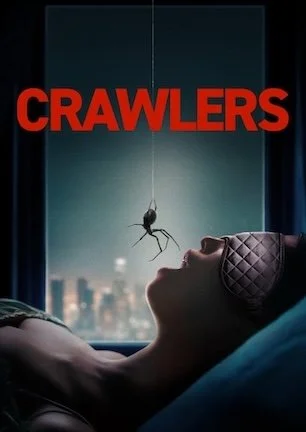
Studio: Saban Films
Director: Angel Gomez Hernandez
Writer: Jayson Rothwell
Producer: Alexandra Milchan, Josh Weinstock, Basil Iwanyk, Erica Lee, Scott Strauss, Peter Welter, Jayson Rothwell
Stars: Matilda Lutz, Gregg Sulkin, Sam Lucas Smith
Review Score:

Summary:
A hard-working maintenance manager and her eclectic tenants fight for their lives when deadly spiders overrun an apartment building.
Review:
“Crawlers” opens on text that rattles off a few supposed statistics. The first is that for every person, there are three million spiders. That seems impossibly high, but whatever. The second says spiders exist in 100% of homes, though I’m not sure how that includes arctic areas or wintry climates. Apparently, we’re never more than three feet away from one, which I find particularly hard to believe. Also, if they ever “decide to eat humans,” the world’s population would be dead within a year. Lol at spiders “deciding” to eat humans.
Being a B-movie more focused on frightful fun than undeniable facts, I don’t feel any need to check the movie’s work on these questionable numbers. I doubt anyone watching a spider-centric horror flick will care much about the truth either. With one final warning that there’s “probably a spider under your seat” right now, “Crawlers” confirms its main objective, really its only objective, is just to creep out arachnophobes with goosebump-giving chills where an insect or animal runs amok.
Although there are one or two visual gags and several snarky lines of dialogue, I’d hesitate to call “Crawlers” a comedy. Its tongue isn’t so much in cheek as lightly licking the roof of its mouth on occasion. The movie mostly gets quick hits of quirk from a typically eclectic roster of moderately eccentric personalities that are more caricatures than characters.
“Revenge’s” (review here) Matilda Lutz headlines as Serena, a struggling musician who barely makes ends meet by doing maintenance work as the live-in manager for Paradiso Palms, a rundown apartment building owned by Mr. Rossmore. You can tell he’s sleazy from the mustache over his smirk as he ogles Serena’s ass, and from the lounge lizard suit that resembles used car salesman couture. You can tell she’s hardworking because she keeps her hair tied back and has cutoff sleeves on the sweatshirt worn while toiling on thankless tasks. You also know Serena is sweet from the way she longingly looks at a keepsake photo of her mother gifting her a guitar when she was a child. Aww.
Mr. Rossmore’s uncaring demand for increased rent forces Serena into awkward interactions that introduce everyone else. There’s an unspoken battle between Esther, a vacant-faced woman who vapes in Serena’s face while colored lights pulse to loud music behind her, and Bradley, an egotistical artist who shoots classic images with Pollock-esque paintballs for auction on Instagram, for who wears heavier eyeliner. Wall Street wannabe Zander wheels and deals over a headset while wearing a suitcoat up top and Lakers shorts down below. Across the hall, easy-to-aggravate tech nerd Lance finds friendship in his pet snake as well as an obedient AI companion he programmed himself.
There are other peculiar residents, but you get the picture of Paradiso Palms’ population. These folks are the obvious fodder for when an unstoppable swarm of venomous spiders needs to feed after bursting out of a professor who recently returned from an expedition in Papua New Guinea, possibly one of the least offensive locations to pin the problem on. Imagine the outrage if the filmmakers went with Wuhan or somewhere in South America.
Not everyone in the building is an a-hole, just most of them. Dressed in nondescript clothing, new father Paul sneaks away from his baby to smoke a cigarette and smile with appreciation for Serena’s songs. There’s also Serena’s young music student Molly, the neglected daughter of a socialite mother, which opens the door for one of the film’s only emotional moments when Molly and a sympathetic Serena solemnly bond over being the latchkey children of single parents.
Those collective details meet the minimum requirements to lay the groundwork for above average creature-feature entertainment. You can’t be overly critical of “Crawlers” because it isn’t built for big drama, big laughs, or even big action. It’s compact, a little claustrophobic, and aimed directly at people who get the creepy-crawlies simply from seeing spiders stalk around. There’s no shortage of shots where someone’s hand, usually Matilda Lutz’s, unknowingly avoids swiping an unnoticed arachnid as swelling music suddenly evaporates once the near-miss moment passes. Such scenes compose most of the movie’s scares, but since “Crawlers” only runs a little over 80 minutes, repeated beats don’t drag the film too far into redundancy.
We need a single word to encapsulate a regular horror movie that’s a step above SyFy, several steps below major motion picture, and somewhere around streaming level that isn’t an automatic throwaway, but nowhere near a must-see either. That’s meant matter-of-factly, not derisively. Whatever that word may be, it fits “Crawlers,” as the movie accomplishes its “get in, get out” mission professionally, albeit imperfectly, which describes most modern horror where low budgets come with low expectations. “Crawlers” doesn’t have the biggest bite by any means, but at least you’ll feel it on your arm before the sting has a chance to completely fade away.
Review Score: 65


“Crawlers” doesn’t have the biggest bite by any means, but at least you’ll feel it on your arm before the sting has a chance to completely fade away.