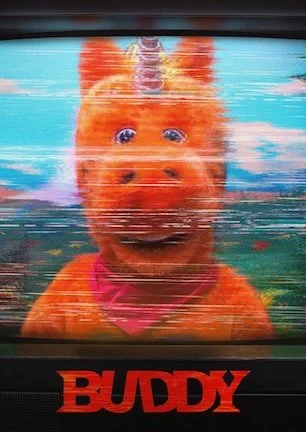
Studio: Saban Films
Director: Casper Kelly
Writer: Casper Kelly, Jamie King
Producer: Tyler Davidson, Drew Sykes, Raphael Margules, J.D. Lifshitz, Tracy Rosenblum
Stars: Cristin Milioti, Delaney Quinn, Tristan Borders, Madison Skyy Polan, Caleb “CJ” Williams, Luke Speakman, Patton Oswalt, Clint Howard, Michael Shannon, Topher Grace, Keegan-Michael Key
Review Score:

Summary:
A children’s TV show morphs from mirthful to macabre when its kids discover the magical singing unicorn who teaches them is actually a manipulative murderer.
Review:
Some filmmaker names instantly inform you you’re about to watch something uniquely creative, that no one else could have made in the same manner. David Lynch became so indelibly associated with dreamlike aesthetics that a specific surreal style is now commonly called “Lynchian.” Nobody documents cringe realism through uncomfortably askew lenses like Nathan Fielder does with his peculiar projects. There are simply certain creators whose imaginations operate on a different frequency than everyone else’s. The works they produce end up being wonderfully weird because of this.
Casper Kelly is one of these people whose offbeat ideas come from somewhere only his mind can find. After “Too Many Cooks,” his 11-minute parody of TV show intros, went viral with millions of views, Kelly twisted a traditional holiday fireplace video into “Adult Swim Yule Log” (review here), a full feature where after a few minutes of fireplace footage, the burning piece of wood goes on a killing spree. Its sequel, “Adult Swim Yule Log 2: Branchin’ Out” (review here), took Kelly’s style of satire further by being a brilliantly bonkers sendup of a typical Hallmark Christmas movie. So when “Buddy” comes touted as his horror film about a Barney-like character who magically traps children in a ‘90s TV show and murders them, you immediately know you’re in for a wild ride through nostalgia and nightmares like only Casper Kelly can conjure.
One of the ways you can tell Kelly runs in unusual circles and keeps an eclectic contact list is by looking at the actors who wanted to participate in “Buddy.” It’s not even close to out of the ordinary for kooky Clint Howard to show up as a disheveled cowboy with an exposed potbelly who is in a same-sex relationship with a wooden marionette. Nor is it unexpected for comedian and prolific voice actor Patton Oswalt to be heard warbling through the zipper of an anthropomorphic backpack. Odd movies are magnets for those guys, and neither of them minds clowning around.
Cristin Milioti, on the other hand, definitely didn’t have to do “Buddy.” Fresh off of winning an Emmy for her performance in “The Penguin,” there’s no way Milioti’s agent wanted her to work alongside an oversized orange unicorn for her follow-up. Kelly’s script sneaked past her people somehow and Milioti personally chose to go all-in on a project that undoubtedly sounded attractively eccentric. Same goes for Michael Shannon, who took time out from touring with his R.E.M. cover band to voice the previously mentioned ventriloquist dummy that makes out with Clint Howard.
“Buddy” has such a quirky narrative structure, a main character doesn’t really emerge until late in the movie. Buddy probably qualifies by default, except he’s almost entirely absent for an 18-minute stretch in the middle. Cristin Milioti may be billed first in the credits, but she doesn’t even appear until this midsection, which starts about a half hour into the runtime. One of the kids on the “It’s Buddy” show, Freddy, holds most of the film’s focus, although it doesn’t always feel that way until everything comes together in the third act.
“It’s Buddy” is a fictional kids TV show from 1999 that mashes “Barney’s” edutainment with “Pee-wee’s Playhouse’s” colorful cast of happy humans and talking furniture. For the first 30 minutes, the film trots through a trio of episodes that get progressively darker as Buddy and company’s lessons about being brave, dancing, and cleaning up shift into suspicions that poorly explained disappearances and shocking sights suggest Buddy might be a psychopathic killer. The entertainment value is high here, as I had a wry smile on my face the entire time with the pitch-perfect parodies of PBS entertainment getting hit hard with hilariously cartoonish carnage.
Out-of-synch viewers might feel the tempo skip when “Buddy” switches off the show and switches to depicting a suburban mother’s life in “reality.” Interestingly though, this is where having an actor of Cristin Milioti’s caliber becomes a big boon for “Buddy.” Milioti doesn’t dare play her part, Grace, for direct laughs, even though she’s in a dark comedy. On the contrary, “Buddy’s” domestic drama is surprisingly strong.
With Topher Grace as Milioti’s husband Ben, the two of them engage in emotional interactions that are subtly funny because of where these more serious pieces are placed. In an ordinary movie, an argument that starts with a wife pleading, “Please be here with me” followed by an upset husband jabbing, “I’m right here, where the hell are you?” while a frowning child overhears from his bedroom would be appropriately heart-wrenching. When sandwiched between a scene where a Lorraine Warren wannabe bumbles through a psychic investigation and Ben flips out at the idea of an imaginary unicorn kidnapping a child he and his wife mysteriously don’t remember, the movie’s horror and humor form a curious choir for a song only “Buddy” can sing.
The tone only trips up on a pair of sexualized scenes whose contributions are questionable. It’s strange for “Buddy” to have its namesake grope Grace while licking her face and forcing her to hug him. Buddy works just fine as a fun villain who goofily giggles and also violently punches an animated clock in post-murder frustration. Making him a pervert for one quick bit doesn’t improve his character at all.
There’s also a scene when Clint Howard’s cowboy tells one of the young girls she “has a pretty face.” It’s the lightest hint of pedophilia possible, and it’s intentionally included for the ick factor. But having him reach toward her at the same time makes for a mildly uncomfortable moment the movie doesn’t even need.
Outside of those stutters, “Buddy’s” powerful engine fires on all cylinders of humor-fueled horror. Once the two separate sections merge, “Buddy” goes back to the show’s fantastical world for more weirdness before becoming a Backrooms-esque liminal nightmare for the finale. There’s so much going on here, from the casual descent into terror to one of the funniest deliveries of the word “b*tch” you’ll ever hear, that “Buddy” becomes a movie you’ll rush to tell other people about just so you can continue talking about it. Few films stick with you like that, and Casper Kelly is one of the few people who can create them.
Review Score: 85
You immediately know you’re in for a wild ride through nostalgia and nightmares like only Casper Kelly can conjure.