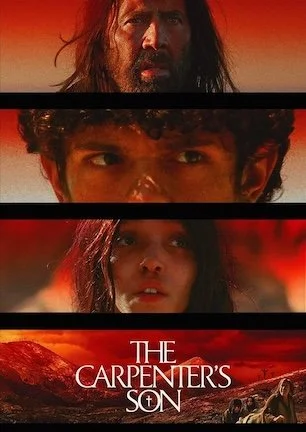
Studio: Magnolia Pictures
Director: Lotfy Nathan
Writer: Lotfy Nathan
Producer: Julie Viez, Alex Hughes, Riccardo Maddalosso, Eugene Kotlyarenko, Nicolas Cage
Stars: Nicolas Cage, Noah Jupe, Isla Johnston, Souheila Yacoub, FKA Twigs
Review Score:

Summary:
Confronted by Satan in disguise, a teenage Jesus struggles to grasp his true identity while his family’s life of fear tests Joseph’s faith in the boy.
Review:
(Jump to the next set of parentheses if you wish to skip the personal anecdote.)
Ironically, my ninth out of twelve years of Catholic school takes the most blame for inspiring me to become skeptical of the religion. As a young kid, I never really gave the Church’s teachings much conscious thought. My elementary-school classmates were in similar boats, so we just innocently went about our everyday childhoods without considering the legitimacy of everything we’d been raised to believe.
This changed at age 14, arguably a little late to still attend mass each week without wondering what value remained in what was now an automated act. But in my high school’s freshman year Theology class, the teacher introduced the concept that not all Bible stories are intended to be taken literally. As an example, he openly laughed at the notion of Adam and Eve being historical figures. That might have been the first time it crossed my mind that, yeah, the idea that a talking snake manipulated a woman molded from a rib bone into convincing a man to bite an apple, and all humans from then on are born sinners unless they’re dunked in magic water under the eyes of a robed celibate speaking a dead language, sounds pretty preposterous.
Huh, I thought. Well then, what other Bible stories are only told as parables? Jesus? Oh no no no, I was assured. Jesus was a real person who definitely existed. That still made sense to me. After all, we have texts from four apostles who walked directly beside Christ to attest to his deeds as verified facts.
That’s when I learned Matthew, Mark, Luke, and John didn’t write the gospels attributed to them. A majority of theological historians date the gospels, which were written in Greek, to somewhere between 70 and 100 A.D., when those four men were almost certainly dead, and highly unlikely to all be writing in a language none of them knew.
My next thought was, wait a minute. You can’t just go around taking books of the Bible and invent malleable criteria to decide what actually happened, what was conjecture, and what was pure fantasy. Then I discovered, well, people already did exactly that. For hundreds of years, various parties held “official” gatherings to determine which books to include and which ones to toss out, with the Council of Trent finalizing the Catholic Church’s Old and New Testaments in the 16th century.
Hold on. You mean to tell me the Bible’s canon was assembled by committee, and there are other texts that aren’t commonly talked about? The mere existence of secret Bible books we weren’t meant to read was already intriguing enough. Turns out these apocrypha also had tantalizing titles like the “Gospel of Judas,” the “Book of Q,” and the “Infancy Gospel of Thomas,” the last of which was rejected as heretical fiction about the missing years in Christ’s untold childhood, which became the inspiration behind “The Carpenter’s Son.”
My fading faith didn’t survive the impact of these dominos falling one after another. Rather than revolt against the religion, however, you could say we mutually uncoupled as incompatible.
What’s recounted above is meant to frame my particular perspective because, whether deliberate or not, “The Carpenter’s Son” automatically invites controversy by presenting a speculative slice of Jesus Christ’s teenage life as a horror movie based on a disputed work. Devout Christians don’t need to know anything else to dismiss the film sight unseen as blasphemous. The other extreme might hope to see the movie be as profane as possible, though they’ll be disappointed to discover “horror movie” in this case does not mean depicting Christ as a vampire hunter or irreverently splattering blood all over his legacy. Those in the middle may find mixed feelings fluctuating everywhere in between according to individual comfort level. Personally, I’m a lapsed Catholic who can take “heretical fiction” with the good humor of a former altar boy and son of a former nun (yes, really), able to smirk at a little sacrilege after a youth full of misspent Sunday mornings.
(Review starts here.)
The premise behind “The Carpenter’s Son” is fascinating for philosophizing. Wipe away the family friendly bedtime tales of comforting angels, gift-bearing wise men, and rapturous followers marveling at water becoming wine, and the objective reality faced by Mary, Jesus, and Joseph seems undeniably terrifying.
The movie sets this tone immediately, depicting the boy’s birth not as a glorious event witnessed by a long-eared donkey or little drummer boy, but with Mary screaming in agonizing pain as she goes into labor. Meanwhile, soldiers searching for the prophesized child tear newborns from other shrieking mothers and send those babies to cruel deaths on a blazing pyre.
“The Carpenter’s Son” portrays Joseph not as the dutiful servant of God the New Testament makes him out to be. Rather, this is a deeply doubtful man wrestling with an incomprehensible concept. Either his wife had an undisclosed affair she refuses to reveal, or she’s telling the truth about a spiritual entity fathering their child. Neither possibility is easy to come to terms with. Yet even if Joseph accepts Mary’s story, how can he know if that spirit was really God or something else, introducing the possibility that Jesus’s supernatural power could be evil rather than divine.
Combining his fictional mother FKA Twig’s perpetually sleepy eyes with his fictional father Nicolas Cage’s characteristically exaggerated expressions, Noah Jupe’s Jesus experiences coming-of-age conundrums only Christ could encounter. “The Boy,” as he’s called because the movie curiously avoids saying all but one person’s name, appears to have an adolescent attraction to a mute girl named Lilith, finding himself unable to avert his eyes when he inadvertently spies her bathing naked. “The Carpenter’s Son” doesn’t go deeper than that in exploring Jesus’s prurient interests, though it does open a door to interpret his attraction as a cause for her subsequent demonic possession.
Jesus’s greater challenge comes from Satan, weirdly pronounced “Suh-tahn” by Cage, disguised as an androgynous youth who lives among lepers and repeatedly coerces Christ into temptation. It’s this “Stranger” who gets in the boy’s ear the most, planting anger-inspiring seeds that Joseph is not his real father, then coaxing out displays of uncanny abilities that threaten to imperil Jesus in addition to his parents.
Although it leaps off this compelling springboard of a family living in fear for their secret identities being exposed, “The Carpenter’s Son” lands in a shallow pool in search of more commanding material. Threads unspooled to explore thoughtful themes go untied as the movie oddly shies away from the platform it creates for fearless fantasizing. It’s as if the film suddenly sees the stones coming its way and decides to dodge before teasing too much danger, eventually detouring into the safer story of Jesus we already know.
“The Carpenter’s Son” earns a 50/50 rating because divided opinions will be roughly equal, as will the responses of those reacting to differing opinions. A popular culture comparison might liken the movie to an inverse “Phantom Menace,” where we witness how a boy thought to be evil instead becomes good, yet with all the cumbersome politicking that bogs down the “Star Wars” prequel. Taking itself so seriously that its contemplative messages turn ponderously stuffy, the horror movie energy suffocates under the weight of the plotting’s sluggishness, as well as the last-minute reluctance to emphasize anything truly audacious.
Review Score: 50
The end credits song lands one last thud to reinforces the impression of a film that wants to be badass when it’s really just a loud lump of noise.