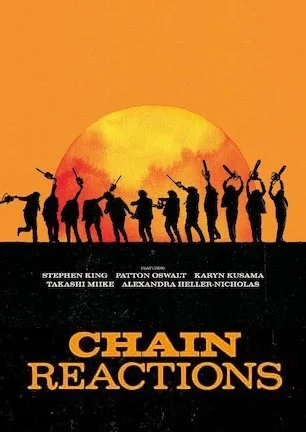
Studio: Dark Sky Films
Director: Alexandre O. Philippe
Writer: Alexandre O. Philippe
Producer: Kerry Deignan Roy
Stars: Patton Oswalt, Takashi Miike, Alexandra Heller-Nicholas, Stephen King, Karyn Kusama
Review Score:

Summary:
Patton Oswalt, Takashi Miike, Alexandra Heller-Nicholas, Stephen King, and Karyn Kusama share personal thoughts about Tobe Hooper’s landmark horror film “The Texas Chain Saw Massacre.”
Review:
Documentaries designed to admire movies encounter issues with audience engagement when the heads doing the talking belong to unknown bodies. Without naming names, I’m thinking of a doc where one man conducted interviews diving into a specific genre, except that man was a relative nobody, and some of the sound bites came from his equally unfamous friends. Asking with the intention of being realistic rather than rude, why should anyone care what essentially random people think about a certain subject they’re not intimately associated with?
Alexandre O. Philippe’s “Chain Reactions” doesn’t have that problem. At least one and up to four of the five faces offering personal musings on “The Texas Chain Saw Massacre” should be recognizable to most viewers. Bookended by two sharp segments where intense admiration for Tobe Hooper’s seminal horror classic leads to genuinely fresh insight on the 1974 film, the midsection is prone to more meandering. So even though these interviewees come with more clout than an average man on the street, sometimes we’re only listening because of who they are, particularly in parts where their thoughts aren’t directly related to “The Texas Chain Saw Massacre” (TCM).
Surprisingly or unsurprisingly depending on what you know of him, comedian Patton Oswalt gets “Chain Reactions” off to a strong start by drilling down into nitty-gritty details about TCM that many fans either forgot or barely noticed. Oswalt’s portion starts with obligatory recollections of his first exposure to TCM and horror in general, a commonality all five guests share. But Oswalt’s pontifications grow more pointed when he starts interpreting possible meanings in the movie.
Perhaps the most intriguing theme he identifies is TCM as a snapshot of American classes, where displaced blue-collar workers slaughter a van full of entitled hippies. Karyn Kusama continues along similar lines in the final segment, and Philippe smartly positions both interviews at opposite ends to give “Chain Reactions” a full-circle feeling instead of five disparate chunks choppily cobbled together.
Filmmaker Takashi Miike’s time is spent more on discussing his own cinematic style than on TCM. Miike credits TCM as both his introduction to horror and greatest influence on his career, tracing straight lines to “Audition” and “Ichi the Killer.” Viewers are poised to come away with new knowledge about Miike, even though that strays away from the documentary’s chief goal.
Wikipedia identifies Alexandra Heller-Nicholas as an Australian film critic and historian. She’s also likely to be unfamiliar to a majority of viewers, which might be why Philippe sandwiches her into the middle of “Chain Reactions” since she’s overshadowed by the names on either side anyway. Heller-Nicholas devotes her discussion to TCM’s regional impact on her home country. In theory, it seems smart to serve up another international perspective to follow Miike’s, except Heller-Nicholas’s contributions conflict with everyone else classifying TCM as a uniquely American product and portrait.
Heller-Nicholas’s notes introduce more head-scratching when she picks individual shots from the movie and expressly ties them to classic artwork. In another moment, she says, “There’s no way the ‘Black Maria’ truck at the end is an accident.” But the other interviewees repeatedly remind us how Tobe Hooper and his team were working with no money and often rolled camera on the fly. The idea that he painstakingly set up a shot to mirror a Rembrandt painting or intentionally sought out that truck because it had the same name as Thomas Edison’s first film company seems preposterous considering how guerrilla Hooper’s production was.
Oddly, Stephen King’s piece of the pie was my most anticipated slice only to end up underwhelming. More than one might expect, King tends to get off track, talking about other titles like “The Exorcist” and “The Evil Dead” even after the TCM bit that provoked his tangent no longer applies.
Around here is also when bigger picture blemishes become more noticeable. “Chain Reactions” hits a visible hurdle when it chooses to repeat the same clips over and over. I don’t know how many more times anyone needs to see Kirk getting hit with Leatherface’s hammer or Pam standing up from the swing. But get ready to see these signature moments again and again as the five featured voices repeatedly return to ground already covered.
Something Philippe does to bandage the bleeding from repetitive footage is to insert snippets from different horror movies that alternatively illustrate the point being made. “Chain Reactions” is visually vibrant, incorporating multiple interview angles and finger-snap editing so the screen never stays still. Sometimes though, the companion clips feel forced into places where they don’t neatly fit. Does Stephen King believe “Skinamarink” (review here) is on par with “Poltergeist?” Highly unlikely, yet clips from both films play while King discusses how suggestive scares require real artists, a questionable attribution to associate with one of those two movies.
Picking up where Patton Oswalt left off, “The Invitation” (review here) director Karyn Kusama rights the listing ship and smoothly sails “Chain Reactions” into port with her revelatory anecdotes. Expounding on the idea of TCM as a reflection of America at the time and in its future, Kusama performs a surgical dissection of who the characters really are and the concepts they represent. Any lingering notions that “The Texas Chain Saw Massacre” is an ordinary grindhouse film with nothing but savagery and slaughter are fully erased by this point, as Kusama’s poignancy presents TCM in a light few eyes would think to see.
How many miles anyone gets out of “Chain Reactions” depends on individual investment not only in TCM, obviously, but in the five subjects speaking. Diehard fans will of course find more meat to chew on while others will get full from the fat of quickly forgotten side stories. As a documentary, Alexandre O. Philippe puts his best foot forward with a concise, polished package, even though inessential material gets included perhaps out of too much reverence for the participants’ celebrity status.
Review Score: 60

You immediately know you’re in for a wild ride through nostalgia and nightmares like only Casper Kelly can conjure.